Marine head rebuild kits and common seal failures
The joker valve in your manual marine head fails predictably, and if you wait for the smell to tell you when, you've already lost a month of your cruising season to a haul-out you didn't need.
TLDR
- Joker valves degrade faster in tropical climates and should be replaced every 6-12 months based on use, not odor.
- Complete seal replacement during rebuild prevents repeat failures from hidden shaft pitting or mineral buildup in hard water regions.
- Experienced cruisers stock multiple rebuild kits and use vinegar soaks instead of bleach to preserve spring and seal integrity.
I pulled the plunger assembly from my Jabsco manual head last November, three weeks into what should have been a six-month Caribbean season. The joker valve looked intact from the outside. When I flexed it, the neoprene split along a hairline crack I hadn't seen. That crack meant every stroke of the pump allowed discharge line backflow into the bowl between flushes. The smell wasn't sewage. It was the slow seep of untreated seawater mixing with residual waste in a 90-degree head compartment.
If you rebuild a marine head only when it stops working, you're doing it wrong. The rebuild interval is a maintenance schedule, not a repair response. Joker valves fail silently for weeks before odor or pump resistance forces the issue. By then, the valve has allowed enough backflow to coat the discharge line with biofilm, and you're not just replacing rubber. You're descaling hose.
The Failure Sequence You Need to Understand
Marine head failures follow a pattern. The joker valve is the first checkpoint because it's the only component that flexes with every pump stroke. In manual heads, this rubber duckbill valve sits at the discharge outlet and opens under pump pressure, then seals shut to block backflow. The neoprene degrades from heat, bacteria, and mechanical fatigue. In tropical climates, expect replacement every six to twelve months depending on use frequency. Cruisers who flush twice daily in the Caribbean report annual replacement. Those who use holding tanks exclusively and flush less often stretch it to 18 months, but that's optimistic.
When the joker valve begins to fail, it doesn't announce itself. The first sign is a faint odor that you dismiss as normal head smell. The second sign is slightly more resistance on the pump handle. By the third sign, weak flush pressure or visible backflow, the valve is already compromised and you've been living with partial seal failure for weeks.
Plunger and pump seals follow a slower degradation curve. These O-rings and gaskets sit in the hand pump assembly and create the suction/pressure differential that moves water. In hard water areas like the Mediterranean or parts of the U.S. East Coast, calcium scaling clogs inlet valves and builds up around the plunger shaft. The mineral deposits act like sandpaper on the seals during each stroke. You'll notice this as a gradual loss of pump effectiveness or water weeping from the pump body. If the boat sits unused for extended periods, the seals dry out and crack. Boats stored in Northern Europe over winter consistently show this failure mode when re-launched in spring.
The shaft seal, less commonly discussed, corrodes from the inside out. Stainless steel shafts exposed to seawater pit over years of service. Once pitting starts, even a new seal won't sit flush against the shaft surface. You'll replace the seal and still see weeping within a few weeks. The only fix is shaft replacement, which most cruisers discover after the second failed seal in the same season.
The Rebuild That Actually Works
A proper head rebuild is a full teardown, not a joker valve swap. Remove the pump assembly entirely. Pull the nose cone to access the internal seals. Inspect the shaft for pitting under magnification. If you see surface irregularities, replace the shaft now or plan to do this again in three months.
Experienced sailors use a 50/50 vinegar and water soak for all metal components overnight before reassembly. This dissolves calcium and mineral scale without corroding springs or degrading new seals the way bleach does. Standard advice calls for bleach-based cleaners, but bleach accelerates spring corrosion and leaves a residue that stiffens rubber components. Vinegar is slower but kinder to the parts you're about to reinstall.
When installing shaft seals, orientation matters. The carbon face must contact the ceramic face, not the reverse. Use only dish soap as lubricant during installation. Oil-based lubricants contaminate the seal surface and cause premature failure. This is the detail that separates a six-month seal from an 18-month seal.
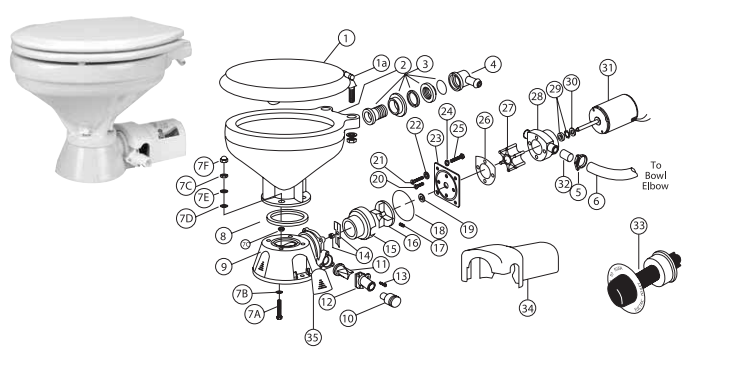
A complete rebuild kit for a typical manual head used on a 40- to 50-foot cruiser should include marine-grade EPDM O-rings, a neoprene joker valve, nylon or reinforced plastic inlet and outlet valves, gaskets for the pump body, and a shaft seal assembly if your head model uses one. Match the kit to your head's exploded parts diagram. Generic kits exist, but verify every component against your specific model before ordering. One wrong O-ring diameter means reassembling the head twice.
What You Should Stock and Why
Cruisers in remote areas stock two to three joker valves, a full seal kit, and an extra shaft. Parts availability in the South Pacific or less-traveled Caribbean islands can stretch to months. Waiting for a part to arrive from the U.S. or Europe turns a two-hour maintenance job into a season-ending equipment failure.
In tropical and humid climates, rebuild frequency increases. Heat and bacteria accelerate neoprene degradation. Annual rebuilds become the baseline, not the exception. Some cruisers install a Y-valve to allow direct ocean flushing, bypassing the holding tank for offshore passages. This reduces seal exposure to waste and extends joker valve life, but it requires an additional seacock and hose run. The tradeoff is worth it if you spend more than half your time offshore.
Hard water regions demand post-rebuild descaling discipline. Flush the system with straight vinegar once every three months to prevent calcium buildup around inlet valves. This adds 15 minutes to your maintenance schedule but prevents the plunger seal failures that occur when mineral deposits abrade the rubber during normal operation.
The Math You Don't See Until It's Late
A joker valve costs $15 to $25 depending on your head model. A full rebuild kit runs $60 to $120. If you wait for failure and the head becomes unusable mid-passage, the cost is a port call you didn't plan for, a haul-out if the failure compromises your offshore schedule, or the indignity of bucket and chuck-it while you wait for parts. None of these outcomes are acceptable on a boat where the head is used daily by two people.
The rebuild interval is every 12 to 18 months in temperate climates, every 6 to 12 months in the tropics, and immediately after any extended layup where seals may have dried. This is not aggressive. This is the maintenance schedule that prevents the failure, not the one that responds to it.
You don't rebuild the head when it smells. You rebuild it on the calendar, and you carry the parts to do it again without waiting for a chandlery to open.
By Jeffrey Pierce