Dyneema or stainless standing rigging replacement
A complete standing rigging replacement is the financial equivalent of a repower, and making the wrong choice means living with that decision for a decade or eating the cost twice.
TLDR
- Dyneema fails visibly with furry external wear you can catch early; stainless corrodes internally where you cannot see it until a strand lets go.
- Oversizing synthetic rigging by one diameter (9mm replacing 8mm wire) and keeping loads below 20% of breaking strength prevents the creep that ruins tension on long passages.
- Reusable hardware on Dyneema drops the cost of your second replacement by two-thirds, while stainless requires full terminal replacement every cycle.
The Post-Mortem
A cruiser crossing from Panama to the Marquesas discovered his port cap shroud had lost 30% of its strength 900 miles out. Not because it broke. Because he installed 8mm Dyneema at the same diameter as his old stainless wire, and the sustained 18-knot trades kept the rig loaded at 25% of breaking strength for eleven days straight. The line didn't snap. It crept. By the time he made landfall, the leeward sag was visible from the cockpit and the forestay had gone slack twice. He retensioned three times at sea, lost sleep, and never trusted the rig again. He went back to stainless in Nuku Hiva and paid for the mistake twice.
That is the danger with Dyneema standing rigging. Not catastrophic failure, which is rare. Permanent elongation under sustained load. Creep is the technical term. What it means in practice is that if you size it like wire, load it like wire, and sail it like wire, you will retension it like a novice until you give up or run out of adjustment. The rule that prevents this is simple: oversize by one diameter, keep working loads under 20% of breaking strength, and accept that the rig will need checking every season. Miss any part of that and you are chasing tension in the middle of an ocean.
The Stainless Baseline
Stainless steel standing rigging has been the default for bluewater boats since the 1960s because it works. Rod or 1x19 wire stays in tension, resists UV, handles point loads at spreaders, and gives you ten years before replacement if the terminals are competently swaged and the wire is 316-grade stainless. The failure mode is well understood: internal corrosion that you cannot see until broken strands appear on the exterior surface. By the time you spot a meat hook, the wire has been compromised for months.
The problem is that stainless rigging quality varies wildly across manufacturers. Inconsistent material grades mean some wire lasts fifteen years in the trades and some fails at seven. You cannot tell by looking. A rigger who knows wire sources and grades is worth the premium, but most cruisers replacing their own rigging buy from a catalog and hope the specs are honest. When stainless fails, it fails without warning after the damage is done internally. You get no advance notice unless you pull the rig and section the wire with a cutter, which no one does.
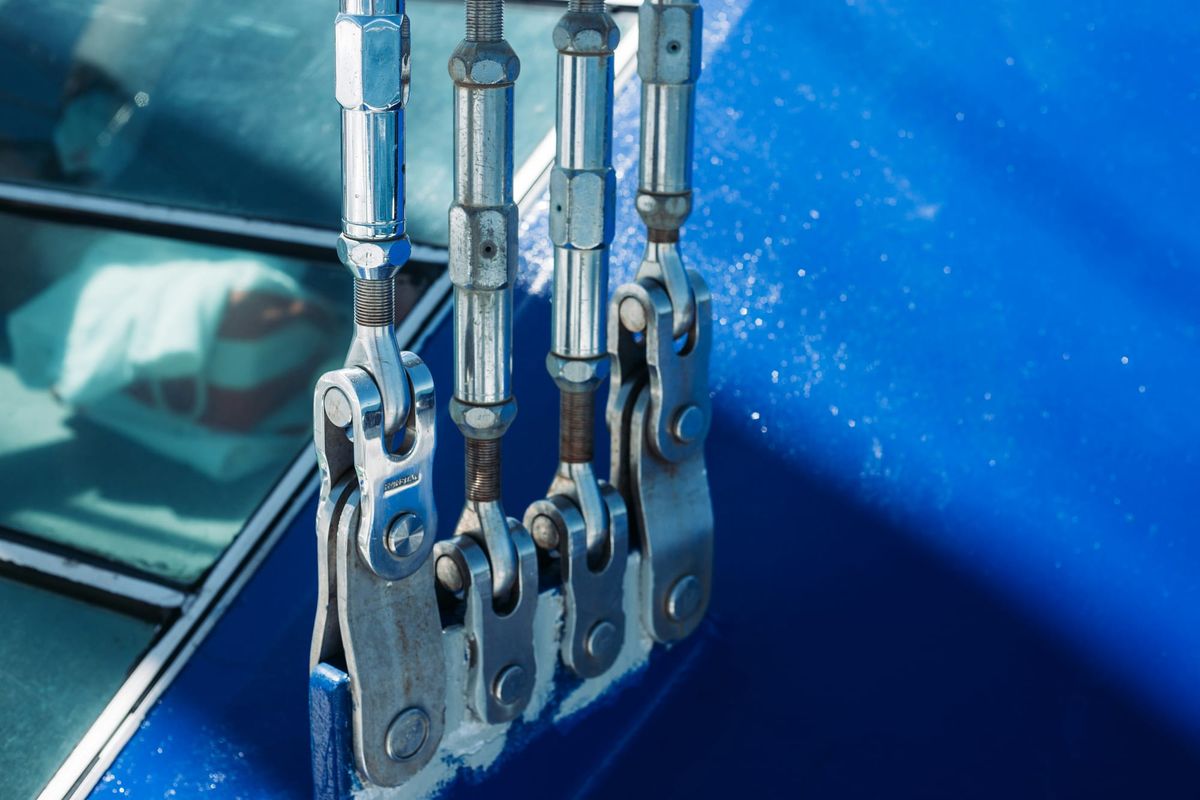
The cost to replace a full stainless rig on a typical 48-footer runs between $4,000 and $7,000 depending on whether you hire the work out or terminate your own wire. Swaging requires a hydraulic press. Mechanical terminals like Sta-Lok or Norseman are DIY-friendly but add $80 to $150 per fitting. Either way, every piece is single-use. When you replace stainless, you are buying the entire system again.
The Dyneema Case
Dyneema-based composite rigging changes the equation in three ways. First, it is 75% lighter than wire of equivalent strength, which matters more than it sounds when you are moving the center of gravity down and reducing pitching moment. Second, it shows wear on the outside. When synthetic rigging starts to fail, the braided sleeve gets fuzzy and the inner core shows through. You can see it during a routine inspection. Third, the hardware can be reused. Deadeye terminals like those made by Colligo or similar allow you to splice new line onto existing fittings. Your second replacement costs a third of the first.
The tradeoffs are real. Dyneema creeps under sustained high load, which means any passage where the rig stays loaded above 20% of breaking strength for days at a time will cause permanent elongation. The solution is to oversize the line. If your stainless shrouds are 8mm wire, you install 9mm Dyneema. That brings working loads down into the safe range and gives you a chafe margin. Chafe is the other concern. Synthetic rigging abrades at spreaders, at the masthead, and anywhere it touches metal under load. Oversizing helps. So does inspecting every 500 miles on passage and adding chafe protection at contact points before you leave.
Temperature variation is the issue no one talks about until it bites. Stainless expands with heat. Dyneema contracts. In the tropics, your synthetic rig will lose tension as the day heats up and regain it at night. You will retune more often than you expect. For cruisers who set the rig and forget it, this is a problem. For those who check their rig weekly and know how to tension a lashing, it is manageable.
When Each Makes Sense
Dyneema makes sense for cruisers who inspect their own rig, carry spare line, and understand splicing. It makes sense if you value light weight and want the option to replace individual stays without pulling the entire rig. It makes sense if your budget includes a second replacement in ten years and you want the reusable hardware to cut that cost. It does not make sense if you are singlehanding long passages and cannot afford to retension at sea. It does not make sense if you are sailing in extreme cold where contraction becomes unpredictable.
Stainless makes sense when you need a rig that holds tension across temperature swings without adjustment. It makes sense when your insurance underwriter does not recognize synthetic rigging, which remains an issue in some European markets. It makes sense if you lack the skills to splice and inspect synthetic line under load, or if your cruising schedule depends on a rigger in a remote port where Dyneema expertise is scarce.
The Real Cost
The argument for Dyneema usually starts with weight and ends with cost. The first replacement costs roughly the same as stainless when you include quality terminals. The difference shows up on replacement two. With reusable hardware, a second Dyneema rig costs $1,500 to $2,500 in materials. Stainless costs the same as the first time. Over twenty years, Dyneema saves you four thousand dollars if you splice your own and inspect regularly. Stainless costs less if you hire the work and the rig lasts twelve years instead of ten.
The failure modes are opposite. Stainless hides damage until it is late. Dyneema shows it early but demands attention. If you are the kind of cruiser who checks your rig, Dyneema gives you warning. If you are the kind who sets it and sails, stainless tolerates neglect better until it does not.
By Jeffrey Pierce