Watermaker Maintenance & Membrane Fouling
Watermaker downtime isn't a maintenance problem, it's a decision you made when you skipped the flush cycle.
TLDR
- Membrane fouling begins the moment you walk away from a half-assed freshwater flush, not when TDS climbs months later.
- Most cruisers troubleshoot symptoms (low flow, high pressure) while ignoring root cause: air intrusion, voltage drop, and prefilter intervals stretched past failure.
- Dedicated pickling protocols and proper electrical system sizing keep membranes productive for years, but running your watermaker just to cycle it will wear components faster than salt air.
I opened my pressure vessel three days into a passage from Key West after watching product flow drop 15% in 48 hours. The membrane smelled like low tide. Not faintly biological, actually putrid, because I'd trusted a flush cycle that never moved enough volume through the element. The brine seal had migrated backward during installation, creating a bypass path that let saltwater contact the product tube. My TDS (total dissolved solids, essentially salt content) spiked to 800 ppm against a normal range under 500 ppm. I had 600 miles to go and two jerry cans as backup.
That failure taught me what the troubleshooting forums won't say outright: watermaker problems are almost never the membrane. They're air leaks you didn't trace, O-rings you reused, prefilters you changed on a schedule instead of a pressure differential, and electrical connections you made in a hurry. The membrane just takes the blame because it's expensive and hidden inside a tube.
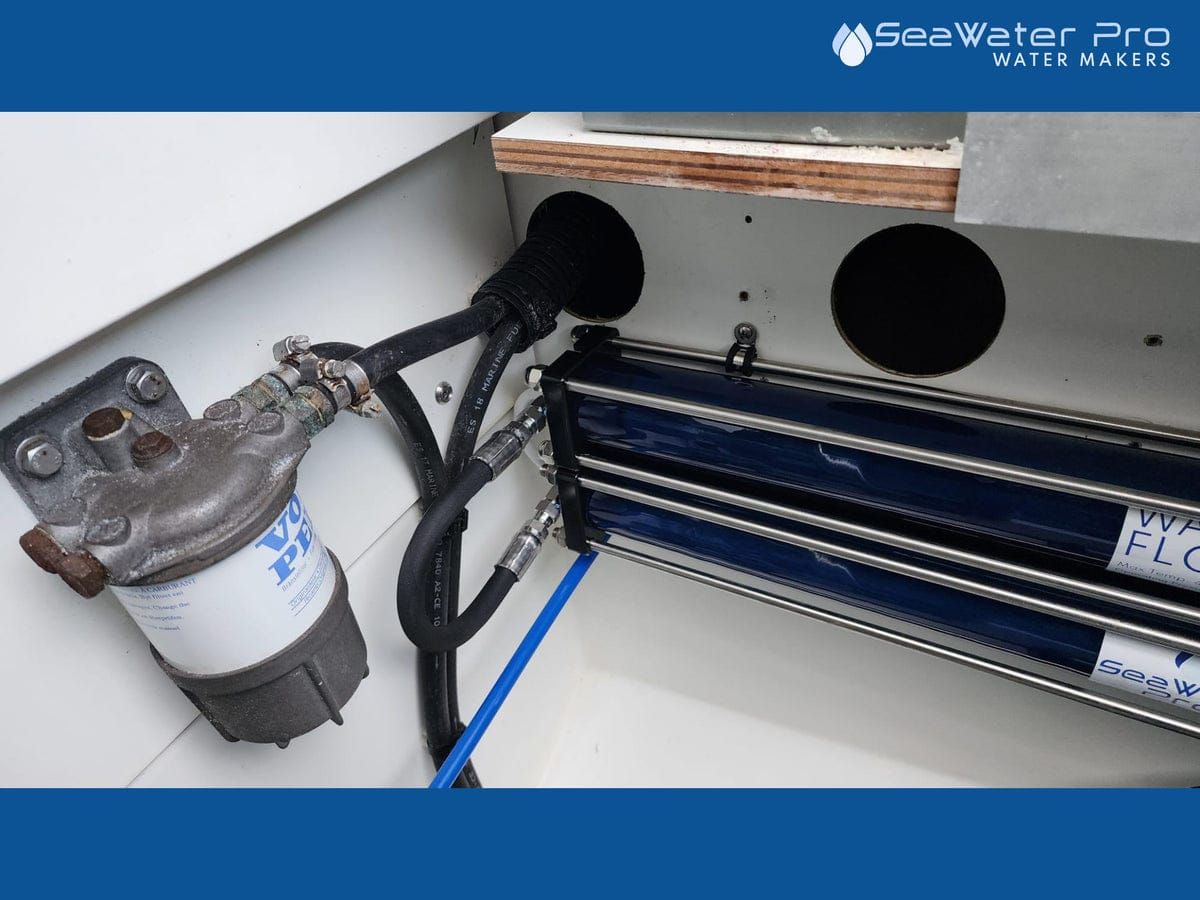
A watermaker pushes seawater through a membrane at high pressure, converting salt water to fresh via reverse osmosis. The basic flow goes: intake seacock, prefilters (typically 20-micron then 5-micron), feed pump, high-pressure pump (800+ psi), membrane in pressure vessel, product water out. Every component between intake and product matters, because any failure point degrades what reaches that membrane.
The Fouling Pathway Most Systems Create
Membrane fouling doesn't happen at sea. It happens at the dock during your layup, or during those stuttering 20-minute run cycles when you're "just making a little water" without flushing properly afterward. Biological fouling needs time and stagnant saltwater. If you run your system, then shut it down without a full freshwater flush, you've left a film of concentrated brine and whatever was living in your intake seacock. That film doesn't rinse out with the next startup. It builds.
Some manufacturers warn about a mistake I see constantly: cruisers connect their flush line to the wrong side of the prefilters, so the rinse water never reaches the membrane housing. It dead-ends in the plumbing, they see flow out the flush drain, and they assume they're good. Meanwhile, the membrane is sitting in a salt bath. When you pickle (preserve with biocide solution, typically 1% sodium metabisulfite) for a passage, if your solution isn't circulating through the element itself, you've just created ideal conditions for biofilm to colonize every surface the next time you pressurize. Replace pickle solution every six months, as biocide effectiveness degrades over time.
Air intrusion compounds this. A pinhole in your intake hose, a loose hose clamp, a dry shaft seal on the feed pump, any of these will let the high-pressure pump run starved. Flow drops. Pressure spikes. The membrane sees inconsistent hydraulic stress. Fouling accelerates in the low-flow zones where brine concentrates instead of flushing. You'll chase this as a "clogged prefilter" for weeks, changing elements while the real problem is 30 inches of intake hose with a stress crack you can't see unless you pull it and flex it under light.
Electrical System Sizing Matters More Than Engine Load
The common advice to run your watermaker off the main engine creates two problems. First, idling a diesel for an hour to make water promotes wet-stacking (incomplete combustion that damages diesels through carbon buildup). Ensure adequate engine room ventilation and never run engines in enclosed spaces without proper exhaust routing and CO monitoring. Second, you're probably pulling 40 amps through an undersized wire run, and by the time that current reaches the motor terminals, you've lost voltage. The pump labors. It overheats. Seals wear faster. You blame the pump. The pump is fine. Your electrical install is not.
I measure voltage at the motor, not at the breaker panel. Voltage drop exceeding 3% under load (ABYC E-11 standard for critical DC systems) indicates undersized conductors or poor connections. I shed everything else on that circuit and check connections with a multimeter, performing voltage drop tests under load. Corroded crimps, inadequate wire gauge, and bad grounds show up as excessive voltage loss. Fix those, and suddenly your "failing" pump runs cool and quiet again.
WARNING: All electrical troubleshooting must be performed with circuits de-energized and tagged out. Never work on live electrical systems without proper training and equipment.
The other issue is running the system too often for short intervals. Manuals often say run it weekly to keep seals wet. Many experienced cruisers say the opposite: run it when you need water, then flush and pickle it properly. Don't cycle it just to cycle it. Every startup stresses the check valves, the pressure switch, the shaft seals. If you're making 10 gallons a week because you can, you're wearing parts for no operational gain. Carry extra jerrycans and run the system on passage when you've got clean water intake and the engine's under load anyway.
Prefilter Changes and the Flow Drop Rule
Your 5-micron prefilter doesn't last on a schedule. It lasts until the pressure drop across it reaches the threshold specified by your filter manufacturer, commonly 5 psi for many marine systems. That might be 40 hours in the Caribbean during a plankton bloom or 150 hours in cold, clear water. Changing it on a calendar schedule is how you end up with a collapsed element that lets debris reach the membrane. Wear eye protection when removing filter housings, and relieve pressure slowly. I keep a differential pressure gauge on my filter housing and swap elements when the gauge says to, not when the calendar does.
The same logic applies to pump wear. I replace high-pressure pump seals when product flow (the freshwater output) drops 10% from baseline. Not when you hit some manufacturer's hour count. Not when you hear a noise. When flow drops. I log flow rate, feed pressure (saltwater input pressure), and product TDS every time I run the system. This discipline takes months to become automatic, so set a phone reminder and tape a laminated log sheet to the bulkhead, or you'll forget when you're tired. Those numbers tell me what's failing before the failure becomes a breakdown. A 10% flow drop with rising feed pressure means the membrane is fouling or the pump is losing efficiency. A 10% flow drop with falling feed pressure means a leak, probably at the pressure vessel end cap or the pump body O-ring.
DANGER: High-pressure watermaker systems operate at 800+ psi. Depressurize completely and follow lockout/tagout procedures before opening any pressure vessel or pump component. Consult your manufacturer's service manual before performing any pressure vessel service. These systems require specific training.
Most pump "failures" are just O-rings. I've pulled pump heads that looked catastrophic, water dripping from the shaft, only to find the main body O-ring had flattened and shifted. Fifteen dollars and 30 minutes, assuming you're not doing it in a seaway with tools sliding around, which is when fifteen-dollar parts become relationship tests. But if you let it drip for a week, that same leak erodes the O-ring groove, scores the shaft, and turns a maintenance item into a parts order with a long lead time.
Temperature affects production significantly. Cold water reduces output by 30-40% compared to tropical temperatures, which panics cruisers who've only run their systems in warm water. This is normal membrane behavior, not a malfunction. Verify your system's temperature compensation specifications.
What You Should Be Carrying and What You're Actually Going to Need
I carry two full prefilter element sets (20-micron and 5-micron), a complete O-ring kit for my pressure vessel, a spare feed pump impeller (the rubber vanes that move water through the feed pump), a set of high-pressure pump seals, a spare check valve, and a spare pressure switch. These last two are common failure points that will shut down your system completely.
The spare membrane question is more complex than forum discussions suggest. If you've fouled a membrane badly enough that it won't recover from a cleaning cycle, chemical cleaning at sea is unrealistic for most cruisers without specialized solutions and recirculation capability. At that point you're managing water consumption (rationing to 3-5 gallons per person per day, relying on jerry cans, planning landfall strategy) until you can source a replacement or reach a port. Some cruisers carry a spare membrane for this reason. Others calculate that the weight, cost, and storage space are better allocated to additional water capacity and more frequent prefilter changes.
For a passage, I pickle with biocide solution at the correct concentration (verify your manufacturer's specification, typically 1% sodium metabisulfite), circulate it through the system, then verify it reached the membrane by slowly opening the sample valve after fully depressurizing and confirming zero pressure on all gauges. Use chemical-resistant gloves and ensure adequate ventilation when handling biocide solutions. I flush for a minimum of five minutes with enough flow to see turbulence in my flush line sight glass. If the flow looks laminar (smooth, glassy), I'm not moving enough volume. I'll ruin a membrane to save 10 gallons of freshwater, which is exactly backward.
When you're 600 miles out and your TDS starts climbing, you're not fixing a membrane. You're managing a compounding failure that started with a decision you made in port. That's the gap this kind of maintenance is designed to close.
By Jeffrey Pierce