Anchoring (and retrieving anchor) in rocky anchorages
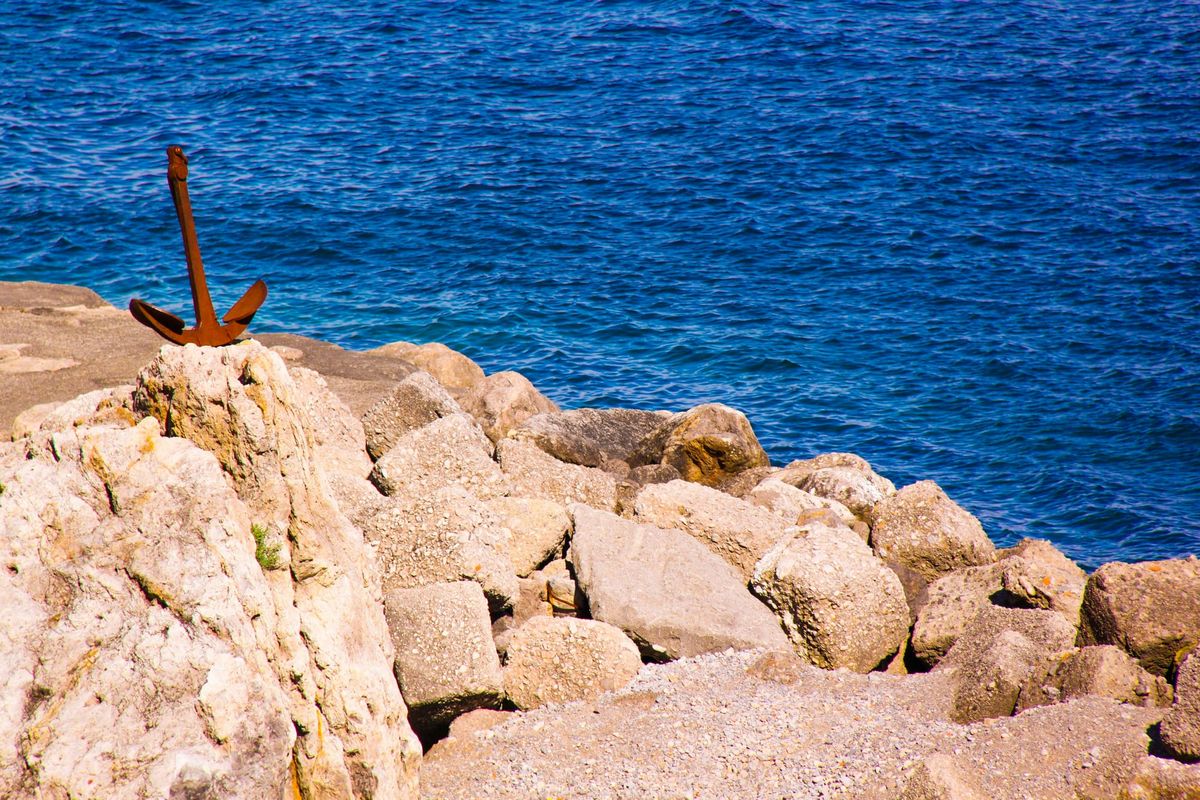
You didn't watch the anchor set, and now your windlass has stopped cold with 40 feet of chain still out and something below hauling back like it's moored to the seabed itself.
Anchoring and Retrieval in Rocky Anchorages
Rocky bottoms will expose every gap in your ground tackle system and every lazy habit you've developed in mud. The anchor that resets itself in sand will trip and drag on smooth basalt. The rode that pulls free with a tug in soft holding will wrap around a submerged stump or wedge between boulders you never saw. And the windlass you trust will stop dead when the load angle goes wrong, leaving you drifting toward a lee shore with no Plan B.
TLDR
- Rocky anchorages demand pre-deployment reconnaissance and post-set verification by eye, not just feel on the rode.
- Standard retrieval under power often fails when the anchor fouls; backward pull geometry and manual assistance become necessary.
- Trip lines are insurance for known foul ground, not routine gear, and must be rigged with scope adjustment to avoid creating new problems.
The Set You Think You Have
The most dangerous moment in a rocky anchorage is not the drag. It's the false hold. Seagrass growing over rock will let your anchor bite into roots just deep enough to feel solid on the snubber. The rode goes slack. The boat settles. You pour the sundowner. Six hours later, a thunderstorm shifts the wind 90 degrees and pulls the whole mess out like a carrot, because grass roots aren't rock and your fluke never touched bottom. You're dragging before you wake up.
This happens in the Bahamas. It happens in the Chesapeake. It happens anywhere the bottom surveys say "grass and rock" in the same sentence. The fouled ground that prevents a clean set also clogs your flukes with weeds and small stones, so even if the anchor repositions during the shift, it won't bite. You'll bounce across smooth rock until something worse stops you.
Verification by dive or snorkel is not extra credit. It's primary procedure. If the water's too cold or deep, a glass-bottom bucket will show you whether your anchor is dug into a crack or sitting on a tilted slab. An anchor alarm will tell you when it's too late. A roster of depth checks over three hours will tell you if the rode angle is changing as tide floods or ebbs, which means the anchor is moving even if the GPS track looks clean.
Geometry Under Load
When an anchor fouls on retrieval, pulling harder from the bow makes it worse. The shank levers against rock. The fluke wedges deeper. The swivel bends or the shackle pin starts to work loose under side load it was never designed to carry. Windlasses are rated for vertical lift to about 20 meters of chain plus the anchor's weight. Beyond that scope or at the wrong angle, the motor will stall, and you're hand-over-handing in a seaway.
The correction is backward pull. Motor or drift past the anchor's position, let the chain go slack, then ease forward slowly while hauling. This reverses the load geometry and often frees a fluke caught on the trailing edge. In warm water, free diving to the anchor and manually rotating the shank works if you can find it quickly. Cold water or poor visibility makes this a guess. The trip line solves this by marking the anchor's crown, but only if you rigged it before you dropped.
A working trip line isn't just a float tied to the crown ring. It's a buoy with a small block on the underside, a length of line adjusted for local depth plus tide range, and a light dive weight at the bitter end to keep it vertical without lifting the anchor off the bottom. Deploy it only when the cruising guide or your own notes flag an anchorage as foul ground, not as routine. The buoy becomes another swinging radius problem in crowded anchorages, and if it snags someone else's rode, you've just created the fouling you were trying to avoid.
What Breaks First
Equipment failure in rock starts with the anchor itself. Danforth-style flukes with flat, stamped steel will bend if one fluke catches between stones and the other tries to pivot. Plow and spade designs handle multidirectional loads better because the geometry resists deformation. That matters in tidal anchorages where the rode swings 180 degrees twice a day and the anchor must reset itself or trip cleanly without jamming.
Shackle pins back out under vibration and cyclic side load. Swivels crack at the barrel when the chain twist combines with impact load from the rode snapping taut in a gust. These are not wear-out failures over years. They happen in hours under conditions rock creates, sharp load reversals and angles that put bending stress where only tension was expected.
Your bitter end should be lashed, not shackled, to the chain locker anchor point. If you need to cut it in an emergency, a knife works faster than trying to unscrew a shackle pin underwater or under load. Inspect that lashing every season. It's the last thing holding you if everything forward fails.
The Anchorages You Skip
Guides written for charter fleets will list anchorages too small and too close to weather shores for boats planning to stay more than a night. Properly sized modern ground tackle can handle hurricane-force winds if you're not also dealing with fetch building across two miles of open water onto a rock ledge 50 feet behind your transom. Swell protection matters more than wind protection when you're choosing where to stop. The guide's "cozy" anchorage with 12-boat capacity becomes a demolition derby when the wind pipes up and boats on different scope start swinging into each other with nowhere to re-anchor.
If the only holding is rock, keep moving. Your $3,500 primary anchor is insurance, not a subscription to unnecessary risk.
By Colin Mather